
If Your Park Feels Like a Maze, Your Flow Design Is the Problem
A kid plays for ten minutes and says they're tired. Parents want to leave. The equipment is fine. The décor is nice. What went wrong?
Most of the time, it's the flow design. The way people move through your space.
I'm Katie. And I'll say it plainly: zone circulation is the most invisible, most fatal part of park design.
Here's what bad flow does. Kids and parents loop around, exhausted. Your best attractions hide themselves. Space gets wasted. Result: short visits, low spending, bad reviews.
Investors pour money into equipment and fit-out. And almost none of them ask the basic question: how does a child actually walk through this building?
What "Child Behavior Flow" Actually Means
Flow isn't just paths. Underneath it is child behavior psychology.
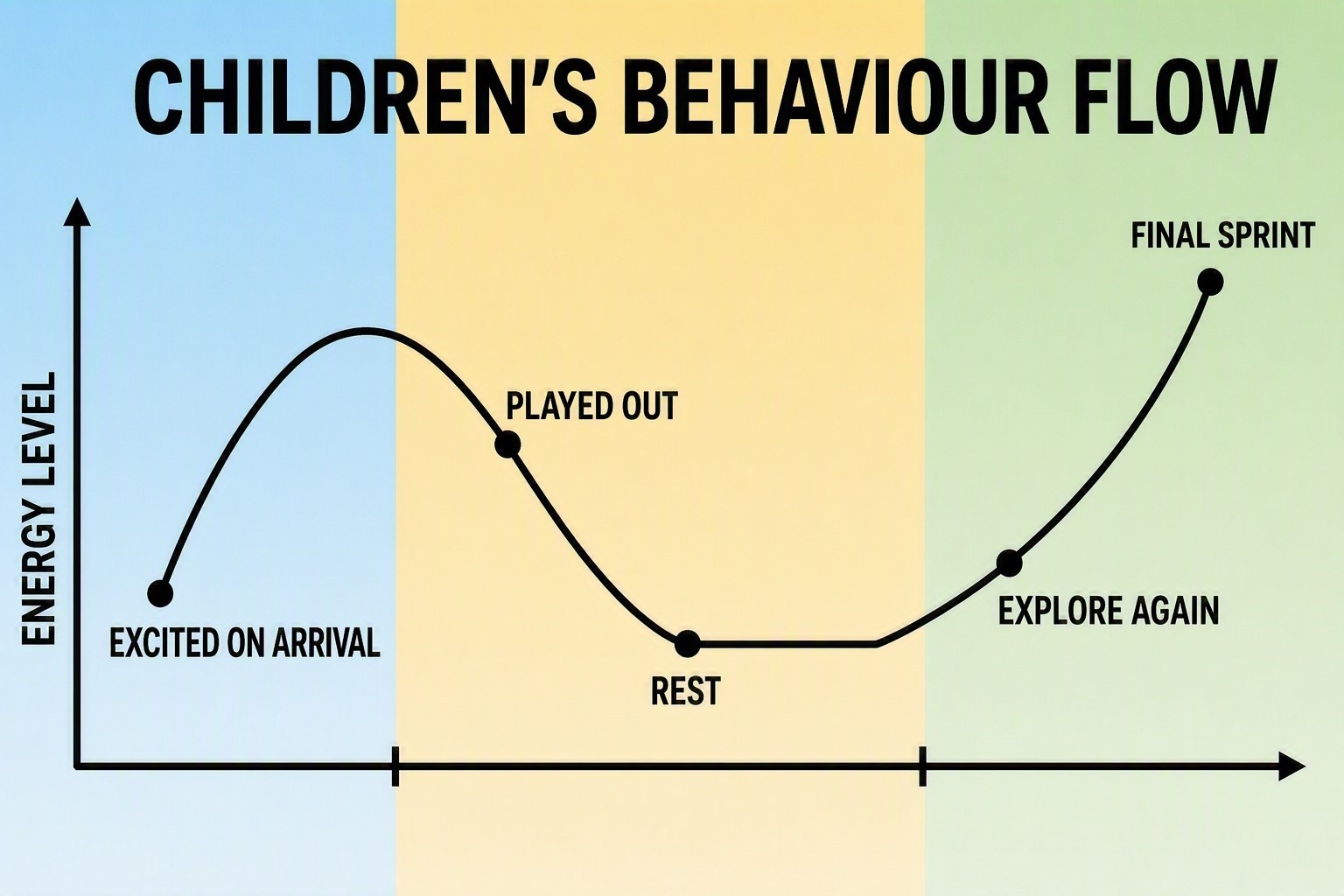
Kids move through a space in patterns:
Walk in, excited. They want the big, high-energy stuff first. Play hard for a while, then they need a buffer. Rest a bit, then they want to explore something new. And near the end, there's the "one last thing" mindset.
Design against that rhythm and you get: "I'm done after ten minutes" and parents chasing kids in circles until everyone's worn out.
Pokiddo's flow design is built on real site observation data. We design zones and routes the way game designers build levels.
Three Principles We Design Around
First: rhythm. High points, buffers, and a finish.
The entrance zone builds anticipation. The kid's first sight should hook them. High-energy zones go early—they release that initial excitement. Mid-energy zones put in parent-child activities, so adults join in. Buffer zones let families sit down—but not boringly. Interactive projection, small games. And near the exit: photo spots and retail. Catch the "last impulse."
Second: discovery. Kids need the feeling of finding things.
If every attraction is visible from the entrance, the child concludes "nothing new here" within minutes. So our flow uses sight blockers and turns. Every corner reveals something fresh.
That sense of discovery is a huge reason kids stay for hours.
Third: parents can see everything.
What stresses a parent most? "I looked away for one second and where did my kid go?"
So our seating areas are placed to see the main activity zones. Parents sit with a coffee, kids play safely. That single detail decides whether a parent comes back a second time.
The Goal: Flow State
All of this is pointed at one thing: a flow experience. The child gets so absorbed in exploring that they don't notice time passing.
When kids are fully engaged, they don't get tired. They don't rush to leave. They don't want to go.
The results are concrete. Visit time extends by 30% or more. Every spending point on the route becomes a natural stop. Kids are happy, parents are relaxed, and the business takes care of itself.
Designing for the Invisible
Flow design is money spent on things nobody sees. But its return is the most real there is.
If you've already found a site and you're stuck on zoning and circulation, our design team has an internal evaluation checklist. It diagnoses existing or planned flow problems fast. Worth checking whether your venue is losing points in the invisible places.
Where This Fits Into the Bigger Picture
Let me connect this to the questions you're actually asking.
When people research how to start a trampoline park, they study trampoline park cost, equipment lists, and revenue models. All important. But the difference between a park that feels right and one that feels exhausting often comes down to flow.
A smart indoor trampoline park design puts the circulation plan on the table before a single piece of trampoline park equipment is ordered. Because every attraction has a natural place in the rhythm. The high-energy zone belongs where the energy arrives. The quiet zones belong where families need a break. Retail belongs at the exit, not buried in the middle.
And when you're comparing trampoline park franchise cost against building independently, add flow design to the checklist. Ask what the model does about circulation, sightlines, and parent seating—not just how many zones it fits in a floor plan.
As a trampoline park manufacturer that has delivered venues across four continents, we've watched parks with identical equipment lists perform completely differently. The variable was never the hardware. It was how people moved through the space.
A park isn't a collection of attractions. It's a sequence of experiences. Design the sequence well, and the attractions take care of themselves.