
To Park Investors: Write a Daily TDL. Manage Your Day, Manage Your Life.
TDL means To-Do List. A simple tool that records what you need to do each day—the task, the priority, the deadline. Its real purpose? It forces you to think clearly before you act. What to do. What to do first. And it gives you the satisfaction of checking things off.
Your habits carry your fate. I believe that sentence completely.
How you spend a day is how you spend your life.

The Manager Who Almost Got Replaced
There's a story I keep thinking about. A manager—her first leadership role—running a team of fifteen salespeople. Performance kept sliding. The pressure was crushing her.
Then her team went above her head. Joint complaint. They wanted her replaced.
Her leader did two things.
First, trust: "I chose you. I believe you can do this."
Second, a tool: "Starting today, write a TDL every morning. Then come tell me why you're doing these things, which ones matter most, how you'll do them, and what value they'll create."
She wrote a TDL every day after that. For years.
That habit took her from a manager her team wanted fired to a leader who built multiple strong teams.
We share this method with park investors at Pokiddo. The shift is visible—from frantic scrambling in the first months to organized calm later.
One store manager told us: "I used to be on my feet all day and at month-end I had nothing to show for it. Now I write a TDL every morning. My head is clear. My team keeps up."

What a Real TDL Isn't
A TDL is not a shopping list. "Have a meeting. Walk the floor. Reply to client messages." That's a log, not a plan.
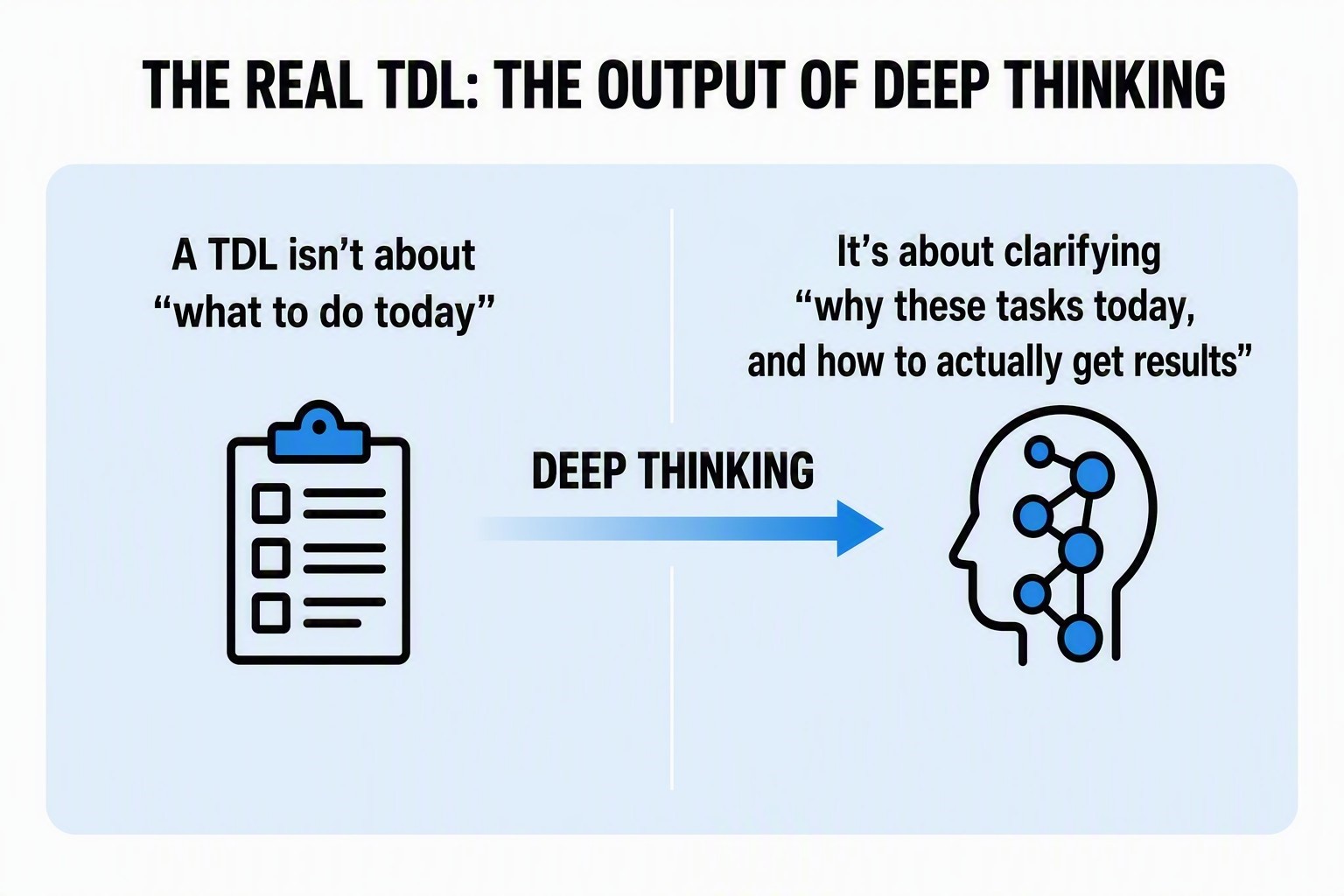
A real TDL is the output of deep thinking. It doesn't just say what you'll do today. It clarifies why you're doing it, and how you'll get a result.
There's a logic we use when we help partner parks set up their operations: think clearly, then act clearly. If you can't think it through, you'll act in a fog.
The value of a TDL is that it forces the thinking.
How to Write a Good One: SMART, Then Six Steps
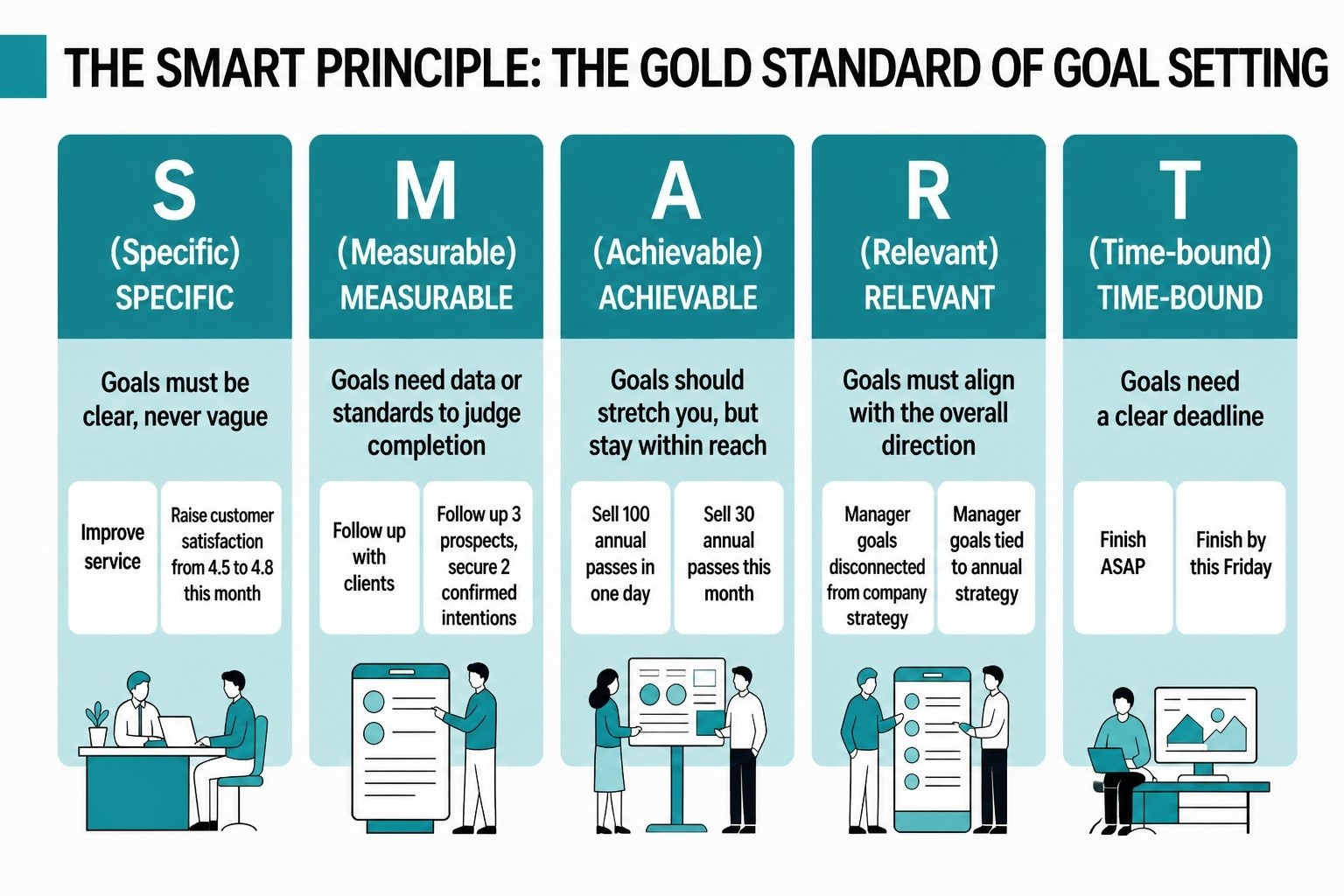
Most strong managers use SMART to test their daily goals.
Specific. Not "improve service." But "raise this month's satisfaction score from 4.5 to 4.8."
Measurable. Not "follow up with clients." But "follow up with three hot leads and get two clear commitments."
Achievable. Challenging, but reachable. Don't set "sell 100 annual cards in one day."
Relevant. Your goals should align with the bigger direction. A store manager's goals connect to the company's annual strategy.
Time-bound. "By Friday" beats "as soon as possible."
Apply SMART to every item on your TDL, and you're no longer listing wishes. You're defining what, by when, and to what standard.
Here's the six-step template we give operators.
Step One: Important Things First
Ten things to do today. Which one first?
Prioritize. No more than three truly important things.
Why three? Energy is limited. The Pareto principle holds: 80% of your results come from 20% of your efforts. Spend your best energy where it produces outcomes.
What counts as important in a park? For a manager: new staff training, a VIP client plan, an equipment safety check. For a salesperson: following up three hot leads, refining your pitch, reviewing yesterday's conversion. For a party host: prepping weekend party supplies, rehearsing a new game flow, calling last week's customers.
Don't overreach. Focus produces results.
Step Two: Define Today's Target
What does "done" look like for each task?
Make it concrete and measurable. "Follow up with clients" isn't a target. "Follow up with three hot leads, secure two commitments" is. "Prep party supplies" isn't a target. "Complete the material list for three weekend parties and confirm inventory" is.
A goal without a standard is not a goal.
Step Three: Think Through the Method
Target set. Now how?
This is the step people skip. Targets get written clearly, then execution falls back to the same old routines—and results stay the same.
You manage people too. How will you drive the team? Meeting or one-on-one? Incentives or methods? Process or outcomes? Think it through before you start. Clear thinking, clear action.
Step Four: Block the Time
Why schedule? Because without a time frame, you drift. You wander into other tasks. You procrastinate—"I'll do it in a bit."
Give every task a deadline. Efficiency follows.
9:00-10:00 morning meeting, align goals. 10:00-12:00 follow up three leads. 14:00-15:00 floor walk, safety check. 15:00-17:00 weekend party plan.
Draw the frame. Efficiency gets its boundary.

Step Five: Results
Today's work, today's finish.
Don't hand today's tasks to tomorrow. Every delay you accumulate becomes debt later.
Check off what's done. Reschedule what isn't.
In a park, most problems are born from delays. A small equipment fault ignored becomes a breakdown. An unresolved complaint becomes a bad review. An unspoken staff issue becomes a resignation.
Clear the day's list. That's the foundation of an efficient team.
Step Six: Reflect
Ten minutes at the end of the day. Two parts.
Gains. What went well? What did you learn? "I used a new angle in a client conversation today and they engaged noticeably more. Worth sharing with the team."
Gaps. What fell short? Where did you miss the plan? "Planned three client calls, made two. Why? Afternoon got interrupted. I need buffer time for the unexpected tomorrow."
Jobs said he reflected nearly every day for 33 years—that it helped him overcome instinct. Reflection compounds. It's how you improve.

A Word for Park Investors
Running a park is daily noise. Staff schedules. Client complaints. Equipment upkeep. Event planning. Reports. You spin like a top all day—and at month-end, the numbers haven't moved.
The problem isn't effort. It's lack of structure.
TDL looks simple. But it forces one thing: deep thinking.
What's the most important thing today? To what standard? How will we actually achieve it? Where does the time go? What did I learn today, and what's missing?
Fifteen minutes a day. That's over ninety hours a year. That's not wasted time. It's saved time. It's your energy pointed where it matters.

Close
Manage your days, and you manage your life.
Each day you refine yourself is a day you become who you intend to be.
At Pokiddo, we pass this culture of continuous improvement to every partner. Because a boss who manages time builds a team that manages goals. And a team that manages goals builds a park that actually makes money.
The daily list is the smallest unit of that. And the smallest unit is where everything starts.
Note on the business numbers: When investors ask about trampoline park cost before anything else, we get it—but the operator's daily system matters more than the initial quote. If you're still weighing trampoline park franchise cost against going independent, add "how does each side support daily management habits" to the comparison. As a trampoline park manufacturer that's watched parks across four continents, we've seen the same truth everywhere: the indoor trampoline park design gets built once, but the daily operating rhythm is rebuilt every morning. And for anyone planning how to start a trampoline park, the TDL habit is the cheapest piece of trampoline park equipment you'll ever buy.