
Stop Asking "How Big Can I Go?" Start Asking "How Much Can Each Square Meter Earn?"
"Katherine, how big a park do you think I could build?"
That's the first question almost every investor asks me. And my answer is always another question: "How much do you want each square meter to earn per day?"
Those two questions are the difference between scale thinking and revenue-per-square-meter thinking. And honestly, one of them builds profitable parks. The other builds expensive storage units.
I'll say it bluntly: I'd rather see you open an 800 sq.m venue where every square meter works than a 3,000 sq.m venue where half of it sits empty. Because I've watched too many investors fall into the "fill the space" trap.
Bigger Is Not Better. Better Is Better.
Here's the pattern we see constantly. An investor gets a large space and their first instinct is to fill it. So the equipment keeps multiplying, the layout keeps expanding, and the area gets packed to the walls. Then opening day comes, and reality hits: half the zones have nobody in them. The fancy attractions become decoration. Revenue spikes only on Saturday afternoons and the rest of the week is a ghost town.
On paper, the park is huge. In practice, half the space is wasted and half the time is dead.
That's the trap of scale thinking: you measure how much space you have instead of how much revenue each meter produces.
Some of our most successful Pokiddo stores—including a venue around 5,000 sq.m—aren't the biggest in their cities. They're just the ones with the highest revenue per square meter. And that's the number that actually matters.
Design That Makes Every Meter Do Double Duty
If you're working out how to start a trampoline park, here's where the design logic separates the amateurs from the operators.
Average park design is flat: draw a grid on the floor, put a climbing wall here, a trampoline there, a slide beside it. Every zone does exactly one thing. When that zone is empty, it earns nothing.
Our design logic is different. We stack functions vertically. The same footprint earns multiple times:
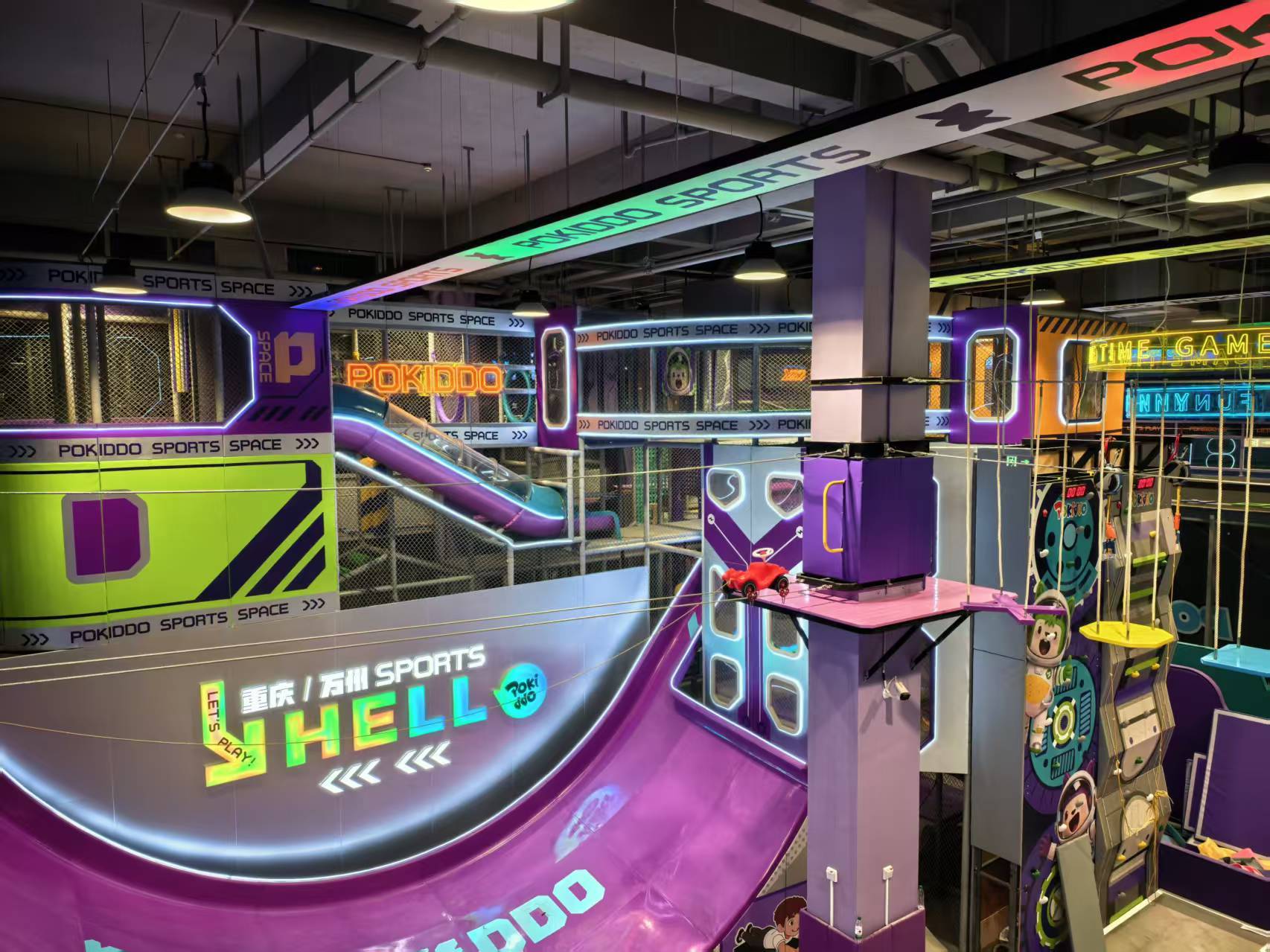
Above a trampoline zone, we add an aerial walkway—suddenly the vertical space that was dead air becomes another revenue surface.
Around a digital interactive zone, we place parent seating—so adults rest AND watch the kids AND order snacks, all from one spot.
A party room wall becomes an interactive projection surface—a game zone during the day, a themed backdrop during parties.
Same area. More content. More scenarios. Every meter working at full value.
This is why a sharp indoor trampoline park design isn't about how pretty the renderings look. It's about how many revenue functions each square meter can hold.
Operations That Fill Every Hour, Not Just the Afternoons
Design solves how space gets used. Operations solve how time gets filled.
Too many parks concentrate their revenue in weekend afternoons. Weekday mornings are empty. Evenings are dead. But here's the part everyone forgets: the rent runs 24 hours, and the payroll runs all day too.
Pokiddo's operational playbook splits the day into segments, each matched to a specific audience:
Weekday mornings: group bookings from nearby kindergartens and schools—kids come during the week for structured programs.
Weekday afternoons: a "parent-child time" package aimed at young families and stay-at-home parents.
Weekday evenings: teen sports training camps that capture after-school hours.
Weekends: family traffic, birthday parties, big events—concentrated release.
With this kind of time-traffic planning, every segment of the day has a matching customer. The same venue suddenly has a much higher revenue ceiling.
The trampoline park equipment mix supports this: attractions that work for a 4-year-old in the morning and a 14-year-old in the evening. Versatility is a feature, not a compromise.
We Don't Draw Equipment Layouts. We Draw Revenue Heat Maps.
When our team designs a park, we aren't placing equipment. We're drawing a revenue heat map.
That map marks four zone types:
High-heat zones for high-revenue attractions.
Traffic-pass zones along the flow path for secondary spending—the arcade, the snack bar, the merchandise.
Buffer zones where parents and kids catch their breath.
Flexible zones that can switch functions by time of day.
The goal: from opening to closing, every hour has the right crowd. From entrance to exit, every corner earns its rent. From Monday to Sunday, every square meter contributes revenue.
This isn't intuition. It's reverse-engineered from data across 60-plus operating venues worldwide.
As a trampoline park manufacturer with that much real-world data, we've learned which layouts produce revenue density and which ones produce empty corners. The difference is rarely the budget—it's the thinking behind the plan.
Do the Revenue Math Before You Sign Anything
So if you have a budget and a site, don't rush to the floor plan. Don't ask "how big can I go?"
Ask yourself: how much can each square meter of this site earn per day?
If you can't answer that question, a bigger space just means a bigger burden.
And before you compare the trampoline park franchise cost against an independent build, run the same revenue-per-meter math on both. A franchise might offer a name, but if the layout and programming don't maximize every meter, you're paying for a logo while the space underneath bleeds.
Your trampoline park cost budget should follow the revenue heat map, not the other way around. Decide what each zone needs to earn, then build the budget to match.
The parks that look "small" on paper but print money every week? They all started with the right question. Not "how big"—but "how much per meter." Ask that one, and everything downstream changes.
Want us to run a revenue-per-square-meter potential assessment for your city and idea? Send us your location and initial concept, and our team will show you where the money actually lives in your floor plan.